






 Funny Folks
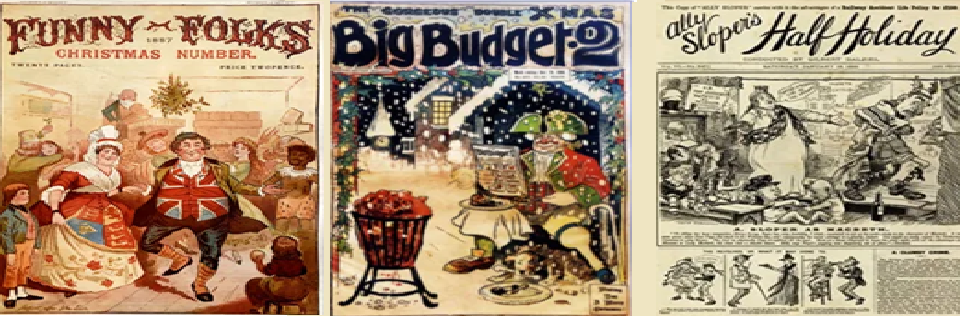
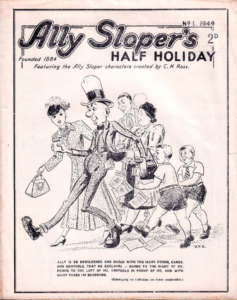
It is generally agreed that Funny Folks (1874 – 1894) became the first publication to meet the accepted definition of a comic. Funny Folks began as a supplement to the Weekly Budget. Its popularity led to it being published as a separate weekly paper. The success of Funny Folks encouraged the publication of other weekly comics. One such comic was the famous Victorian comic, Ally Sloper’s Half Holiday (1884 – 1916). Ally Sloper’s Half Holiday was the inspiration of the engraver and publisher, Gilbert Dalziel. Ally Sloper had a characteristic red nose, battered top hat and he was usually drunk. Ally Sloper is notably the first ever comic strip hero and undoubtedly laid the foundations for the likes of Chubblock Homes (Comic Cuts), Weary Willie and Tired Tim (Illustrated Chips), Roy of the Rovers (Tiger), Desperate Dan (The Dandy), Dan Dare (The Eagle) and more recently Judge Dredd (2000AD). These are but a few names from the canon of British Comic heroes.
Illustrated Chips
 The late 1890s saw an explosion in comic publishing. Alfred Harmsworth’s Comic Cuts (1890 – 1953) cost just half a penny, which was half the cost of its contemporaries. Comic Cuts soon had competition from rival publishers with titles such as Funny Cuts (1890 – 1920). Harmsworths response was to bring out further titles of his own including Illustrated Chips. Although these publications were classed as comics, they were primarily aimed at and published for an adult audience. Comics for young children (Nursery Comics) didn’t start being published until the early years of the twentieth century. Rainbow (1914 – 1956) is generally accepted as the first children’s comic although Puck (1904 – 1940) did have a junior section after issue eleven and gradually became a children’s comic.
Puck was the first comic to print a s substantial number of its pages in colour but it wasn’t until Mickey Mouse Weekly (1936 – 1955) that a comic was published completely in full colour photogravure. Photogravure is a picture produced from a photographic negative and transferred to a metal plate where it is etched on.
The Beano and The Dandy
The 1930s are known as the Golden age of comics. The Golden age saw the appearance of comics like Tiny Tots (1927 – 1959), Crackers (1929 – 1941), The Dandy (1937 – 2012) and The Beano (1938 – Present). Both the Beano and the Dandy appeared just prior to the outbreak of the 2nd World War and their timing can be considered fortunate because paper shortages led to laws prohibiting the launching of new comics during the war years. The Beano and Dandy became a vanguard of a new era with the introduction of a new size and style of comic artistry, which included the introduction of speech bubbles in some of the stories.
The success of the two DC Thomson titles (Beano and Dandy) led Thomson’s rivals, The Amalgamated Press, to launch two of their own rival comics namely Radio Fun (1938 – 1961) and Knockout (1939 -1963). Although The Beano and Dandy are still continuing to be published, Radio Fun and Knockout ended their days in the early 1960’s. In July 1939 DC Thomson had launched a comic called The Magic Comic (1939 – 1941) but it was short lived due to the over saturation of the comics market at that time. With the closure of The Dandy, The Beano is now the oldest British comic still in publication.
Eagle
 The 1950s is known as the Silver Age and it saw the appearance of a more sophisticated type of comic epitomised by the Eagle (1950 – 1969) with its hero Dan Dare. The silver age comics were post war publications and gone were the paper shortages of the war years, these comics were printed on a better quality paper with full photogravure.
No history of British comics would be complete without paying homage to the great Denis Gifford who was born on Boxing day 1927. Gifford’s contribution to British comics both as a contributor in the 1940s and 1950s, including Flip & Flop’, and historian is immeasurable. Gifford, who died in 2000 aged 72, wrote over fifty books on British comics which included ‘The Best of the Eagle (1989).
Such was his passion for comics that he stored any edible free gifts in his fridge and his home became so overwhelmed by his collection of over 20, 000 comics that it became difficult for him to move around his home. Denis Gifford had collected comics from an early age and his collection had included the first issue of The Dandy with its free gift of a tin whistle. The first issue of The Dandy and the other comics in his collection were lost when he was evacuated during the Second World War. Although vehemently denying any involvement, his mother remained prime suspect for disposal of the comics during his absence.
Denis Gifford
 In the early 1940s, Gifford began drawing for The Dandy after sending in a drawing to The Dandy publishers, DC Thomson in Dundee, Scotland. It was during this time while he was at Dulwich College that he made friends with Bob Monkhouse. Not only did Bob Monkhouse and Denis Gifford later go on to produce their own comic together but they also gave concerts together when they served in the RAF with Monkhouse being the straight man to Gifford the comedian.
Once the war was over, Gifford returned to his love of drawing and worked as a freelance artist working for newspapers such as the London evening News and the Sunday Despatch. He worked as a freelance artist until the 1960’s when he started creating panel games for radio including Sounds Familiar which later successfully transferred to television as Looks Familiar. Gifford had many successes with television and worked for ITV, BBC and worked on designing stunts for The Generation Game.
However, Gifford’s first love was British comics and in particular Christmas issues. Gifford once said “I loved the way the snow used to hang over the title on the front page and the last page was always a Christmas party”.
The first British Comics Convention which was held in 1976 was organised by Denis Gifford who managed to bring together over 250 dealers and artists.
 Gifford and Monkhouse remained friends and shortly before his death worked on a two part radio show entitled A Hundred Laughs for a Ha’penny which was a history of comic papers.
Gifford’s books included ‘The British Film catalogue 1895 – 1995 (1986) which took him twenty years to complete, Laughter in the Air (1979) Run, Adolf, Run (1975, a compilation of cartoons from the war), The Best of Girl Annual (1952-1959), Monsters of the Movies (1977), The Great Cartoon Stars (1979), The Complete Catalogue of British Comics (1985).
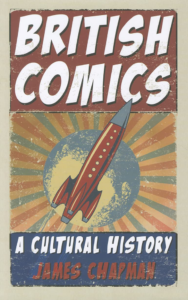
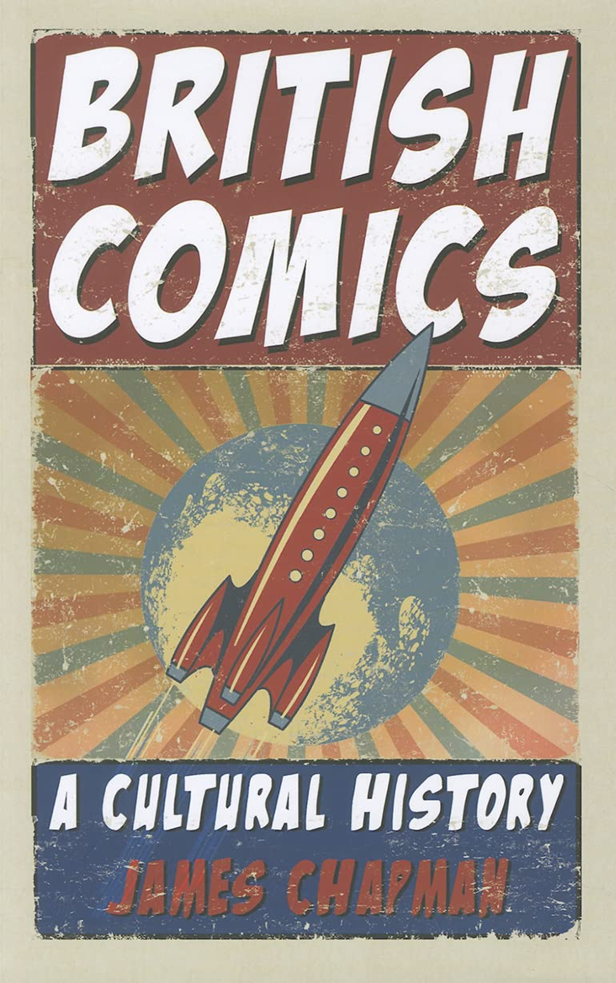
British Comics – A Cultural History
by James Chapman
Buy Here
Chronology
2000 AD : 26th February 1977 –
Acne : August 1991 – September 1993
Action : 14th February 1976 – 12th November 1977
Adventure : 17th September 1921 – 14th January 1961
Ally Sloper’s Half-Holiday : 3rd May 1884 – 9th September 1916
Beano, The : 30th July 1938 –
Beanomax : 15th February 2007 – June 2013
Beezer, The : 21st January 1956 – 21st August 1993
Big Comic, The : 17th January 1914 – 28th September 1918
Bimbo : 18th March 1961 – 22nd January 1972
Bo-Peep and Little Boy Blue : 19th October 1929 – 14th April 1934
Bubbles and the Children’s Fairy : 16 April 1921 – 24 May 1941
Buster : 28 May 1960 – 4th January 2000
Butterfly : 17 Sept. 1904 – 18 May 1940
Champion : 28 Jan. 1922 – 19 March 1955
Chicks’ Own : 25 Sept. 1920 – 9 March 1957
Chuckler (Bath) : 31 March 1934 – 15 Oct. 1938
Chuckles : 10 Jan. 1914 – 1 Dec. 1923
Coloured Comic : 21 May 1898 – 28 April 1906
Comet : 14 Jan. 1950 – 17 Oct. 1959
Comet (Sale) : 20 Sept. 1946 – 17 Oct. 1959
Comic Cuts : 17 May 1890 – 12 Sept. 1953
Comic Home Journal : 11 May 1895 – 10 Sept. 1904
Cor!! : 6 June 1970 – 15 June 1974
Crackers : 23 Feb. 1929 – 31 May 1941
Dandy : 4 Dec. 1937 – 4th December 2012
Dazzler (Bath) : 19 Aug. 1933 – 8 April 1939
Eagle : 14 April 1950 – 2 March 1963
Eagle and Swift : 9 March 1963 – 26 April 1969
Favorite Comic : 21 Jan. 1911 – 31 March 1917
Film Fun : 17 Jan. 1920 – 8 Sept. 1962
Firefly : 20 Feb. 1915 – 31 March 1917
Flintstones and Friends : 7 May 1988 – 25 March 1989
Frolix: The Children’s Weekly Comic : [Aug. 1928] – 9 May 1930
Funny Cuts : 12 July 1890 – 3 July 1920
Funny Folks : 12 Dec. 1874 – 28 April 1894
Funny Wonder : 4 Feb. 1893 – 25 May 1901
Funny Wonder : 2 Jan. 1915 – 25 May 1940
Coloured Comic: 16 July 1898
Favorite Comic: 13 January 1917
Giggle: A Chidren’s Comic : 29 April 1967 – 13 Jan. 1968
Girl : 2 Nov. 1951 – 3 Oct. 1964
Golden : 23 Oct. 1937 – 11 May 1940
Golden Penny Comic : 14 Oct. 1922 – 28 Jan. 1928
Halfpenny Comic : 22 Jan. 1898 – 29 Dec. 1906
Hey Diddle Diddle : 25 March 1972 – 15 Sept. 1973
Hornet : 14 Sept. 1963 – 7 Feb. 1976
Hwyl! (Liverpool) [Welsh] : July 1949 – Summer 1989
Illustrated Chips : 26 July 1890 – 23 Aug. 1952
Its a Hoot : 26 Oct. 1985 – 25 Oct. 1986
Its Wicked : 27 May 1989-
Jack and Jill : 7 March 1885 – 7 May 1887
Jack and Jill : 27 Feb. 1954 – 29 June 1985
Jackie : 11 Jan. 1964 – 3 July 1993
James Bond Jr. : 1 Oct. 1993 – 4 Feb. 1994
Jester : 27 Jan. 1912 – 18 Dec. 1920
Jester : 23 Feb. 1924 – 18 May 1940
Jester and Wonder : 24 May 1902 – 20 Jan. 1912
Jim Henson’s Muppet Babies : 3 Jan. 1987 – Sept. 1988
Jingles : 13 Jan. 1934 – 29 May 1954
Jinty : 11 May 1974 – 21 Nov. 1981
Joker : 18 July 1891 – 28 Oct. 1897
Joker : 5 Nov. 1927 – 18 May 1940
Jolly Comic : 19 Jan. 1935 – 28 Oct. 1939
Jolly Jester : 25 Dec. 1920 – 16 Feb. 1924
Kinema Comic : 24 April 1920 – 15 Oct. 1932
Krazy : 16 Oct. 1976 –
Larks : 1 May 1893 – 29 Dec. 1906
Larks : 29 Oct. 1927 – 18 May 1940
Little Sparks 24 April 1920 – 30 Sept. 1922
Lot-o’-Fun : 17 March 1906 – 16 Feb. 1929
Jack and Jill : 2 January 1886
Lot-o’-Fun : 24 April 1926
Mandy : 21 Jan. 1967 – 5 May 1991
Mask : [1986 preview issue]; 3 Jan. 1987 –
Merry and Bright : 22 Oct. 1910 – 19 Jan. 1935
Mickey Mouse Weekly : 8 Feb. 1936 – 24 Sept. 1955
Mirabelle : 10 Sept. 1956 – 22 Oct. 1977
Monster Comic : 23 Sept. 1922 – 25 Jan. 1930
My Favourite : 28 Jan. 1928 – 13 Oct. 1934
Nuggets : 26 Nov. 1892 – 10 March 1906
Picture Politics : March 1894 – Feb. 1914
Picture Fun : 16 Feb. 1909 – 3 July 1920
Pippin : 24 Sept. 1966 – 26 Sept. 1986
Playbox : Nov. 1904 – May 1910
Playbox : 14 Feb. 1925 – 11 June 1955
Pow! [and Wham!] : 21 Jan. 1967 – 7 Sept. 1968
Princess : 30 Jan. 1960 – 16 Sept. 1967
Puck : 30 July 1904 – 11 May 1940
Rainbow : 14 Feb. 1914 – 28 April 1956
Rattler (Bath) : 19 Aug. 1933 – 15 Oct. 1938
Real Ghostbusters : 26 March 1988 – Sept. 1992
Robin : 28 March 1953 – 25 Jan. 1969
Romeo : 31 Aug. 1957 – 14 Sept. 1974
Roxy : 15 March 1958 – 14 Sept. 1963
Roy of the Rovers : 25 Sept. 1976 – 22 Sept. 1990
My Favourite : 8 December 1928
Playbox : 14 February 1925
Scraps : 1 Sept. 1883 – 30 April 1910
Smash : 5 Feb. 1966 – 3 April 1971
Snap-Shots : 9 Aug. 1890 – 19 Nov. 1907
Sparkler : 20 Oct. 1934 -5 Aug. 1939
Sparks : 5 Oct. 1918 – 17 April 1920
Sparky : 23 Jan. 1965 – 16 July 1977
Star Wars : 8 Feb. 1978 – 7 June 1986
Sun : 20 Jan. 1948 – 17 Oct. 1959
Sunbeam : 7 Oct. 1922 – 25 May 1940
Superted : 10 March 1990 – Dec. 1995
Swift : 20 March 1954 – 2 March 1963
Tammy : 6 Feb. 1971 – 23 June 1984
Teddy Bear : 21 Sept. 1963 – 15 Sept. 1973
Tiger Tim’s Weekly : 31 Jan. 1920 – 18 May 1940
Tiny Tots : 22 Oct. 1927 – 24 Jan. 1959
Tip Top : 21 April 1934 – 29 May 1954
Topper : 7 Feb. 1953 – 15 Sept. 1990
Treasure : 19 Jan. 1963 – 16 Jan. 1972
TV Comic : 9 Nov. 1951 – 22 June 1984
Twinkle : 27 Jan. 1968 –
Valentine : 19 Jan. 1957 – 9 Nov. 1974
Valiant : 6 Oct. 1962 – 3 April 1971
Victor : 25 Feb. 1961 – 21 Nov. 1992
Whizzer and Chips : 18 Oct. 1969 – 27 Oct. 1990
Wonder : 30 May 1942 – 12 Sept. 1953
World’s Comic : 6 July 1892 – 10 Nov. 1908